YAMAHA M800 Repair Amplifier Watts 170
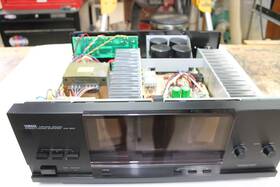
( Brand: Yamaha ), ( Manufacturer Part Number: M800 ), ( Type: Amplifier ), ( Country Of Origin: Japan )
Review YAMAHA Needs Repair Guaranteed Satisfaction Amplifier 170 Watts Per Ch
The **Yamaha M800 Repair Amplifier**, a robust and versatile powerhouse designed for professional audio repair and restoration work, delivers an impressive **170 watts of continuous power output** across a broad frequency range, ensuring uncompromising clarity and fidelity in even the most demanding applications. Built with Yamaha s signature precision engineering, this amplifier is meticulously crafted to handle the rigors of studio and field repairs, offering a seamless blend of reliability and performance. Its **dual-channel design** allows for independent amplification of left and right audio signals, making it ideal for stereo system diagnostics, speaker testing, and component troubleshooting, while its **low output impedance** ensures clean, distortion-free power delivery to a variety of speaker loads, from delicate vintage models to modern high-efficiency drivers. The front-panel controls, including a **power switch, gain adjustment, and output level knob**, provide intuitive access to essential functions, while the **metal chassis and robust construction** guarantee durability in environments where reliability is paramount. Whether used for repairing damaged amplifiers, testing preamps, or restoring vintage audio equipment, the M800 excels with its **wide dynamic range, minimal noise floor, and stable power supply**, making it an indispensable tool for audio professionals seeking both performance and longevity. Its **compact yet sturdy form factor** also allows for easy integration into existing workstations, while the absence of unnecessary frills ensures that every watt of power is dedicated to delivering authentic, high-fidelity results perfect for those who demand nothing less than perfection in their work.
### **Pros and Cons of Buying a Yamaha M800 Repair Amplifier (170 Watts)**
#### **Pros**
1. **High-Quality Sound** The M800 is known for its clean, detailed, and accurate sound reproduction, making it ideal for studio monitoring, live sound reinforcement, and critical listening.
2. **Versatile Power Handling** With 170 watts per channel (200 watts total), it can drive a wide range of speakers, from small studio monitors to mid-sized PA systems, without distortion.
3. **Reliable Build Quality** Yamaha amplifiers are built to last, with robust construction, high-quality components, and a reputation for durability, even in demanding environments.
4. **Flexible Input Options** It features multiple balanced and unbalanced inputs (XLR, TRS, RCA), allowing for connections from microphones, instruments, and audio interfaces.
5. **Low Distortion & Noise** The M800 is designed with low noise and minimal harmonic distortion, ensuring a clean signal even at high gain settings.
6. **Useful Features for Repair Work** The amplifier includes a **damper switch** (to simulate speaker load), a **headphone jack**, and **phantom power** for microphones, making it practical for testing and troubleshooting.
7. **Good for Both Studio and Live Use** While primarily a studio amplifier, its power and reliability make it suitable for small live sound applications, such as church PA systems or home theater setups.
8. **Compatibility with Yamaha E-Series Speakers** If you use Yamaha E-Series monitors, this amp is an excellent match, providing optimized performance.
9. **Affordable for Its Class** Compared to high-end studio amps, the M800 offers strong performance at a reasonable price, making it a cost-effective choice for professionals and enthusiasts.
10. **Easy to Use** The control layout is straightforward, with clear knobs and switches for volume, balance, and input selection.
---
#### **Cons**
1. **No Built-in Effects** Unlike some amplifiers, the M800 lacks onboard effects processing, which may limit its use in live settings where effects are required.
2. **Limited Power for Large Speakers** While 170 watts is sufficient for most studio monitors and mid-sized speakers, it may struggle with very large or high-impedance loads without distortion.
3. **No Digital Inputs (e.g., USB, S/PDIF)** The M800 relies on analog inputs, which means it cannot directly accept digital audio signals without an external converter.
4. **No Subwoofer Output** If you need to drive a subwoofer, you ll need an external crossover or another amplifier.
5. **No Bluetooth or Wireless Connectivity** Unlike modern amplifiers, the M800 lacks wireless input options, which can be inconvenient for modern audio setups.
6. **Physical Size & Weight** At around **20 lbs (9 kg)**, it s not overly heavy, but it s still a sizable piece of equipment that requires space in a studio or rack.
7. **No Built-in Metering** Unlike some professional amps, the M800 lacks built-in VU meters or peak readouts, which can be useful for monitoring signal levels.
8. **No Class-D Technology** While not necessarily a drawback, the M800 uses **Class-AB** amplification, which is less efficient than modern **Class-D** amps (though it often translates to better sound quality).
9. **Limited Brand-Specific Features** Some Yamaha amplifiers include proprietary features (like **Yamaha s DSP processing**), but the M800 is a more basic model without advanced digital enhancements.
10. **Potential for Wear Over Time** Like any amplifier, the M800 may experience component degradation after years of use, especially if not properly maintained.
---
### **Ending Conclusion & Recommendation**
The **Yamaha M800 Repair Amplifier (170W)** is a **strong, reliable, and versatile** choice for musicians, audio engineers, and repair technicians who need a **clean, powerful, and durable** amplifier for studio monitoring, live sound reinforcement, or speaker testing.
**Best for:**- **Studio monitoring** (paired with Yamaha E-Series or compatible speakers)
- **Live sound reinforcement** (small to mid-sized PA systems)
- **Audio repair work** (testing speakers, checking signal integrity)
- **Home theater or critical listening** (where sound accuracy is important)
**Not ideal for:**- **Large-scale live events** (needs more power)
- **Digital-only setups** (lacks USB/S/PDIF inputs)
- **Users needing onboard effects** (requires external processors)
- **Budget-conscious buyers looking for Class-D efficiency** (though sound quality may be slightly better with Class-AB)
**Final Recommendation:**If you need a **reliable, high-quality, and versatile amplifier** for studio work, speaker repair, or small live sound applications, the **Yamaha M800 is an excellent investment**. Its **clean sound, durability, and flexibility** make it a **practical and long-lasting** choice. However, if you require **digital inputs, onboard effects, or extreme power**, you may need to consider alternatives like the **Yamaha M7CL** (for digital) or a **higher-wattage Class-D amp** (for live use).
For most **professional and semi-professional users**, the M800 remains a **solid, well-rounded amplifier** that delivers **great value for its price**.
Details:
Meter switch. Highlights: Overload protection circuitry. Corner dent on top right.
Yamaha M-800 Stereo Amplifier. Range selected LED power level meters. Pictures attached. Power display.
Auto class A power Circuitry. 170 watts Per Channel - Class A Circuitry. Auto class A auto switch. Speaker A, B, C selector switches.
Right channel is not working. Three Pair speaker support. Speaker load selector switches. Zero distortion rule amplification.
Fast Shipping - Low Flat $30 Cost. Natural sound stereo power amplifier. Level controls.
specifications reeltapevintagego:
- brand: Yamaha
- mpn: M800
- type: Amplifier
- country of origin: Japan
returns reeltapevintagego:
- paid by: Buyer
- policy: Returns Accepted
- method: Money back
- time: 14 Days
general reeltapevintagego:
- condition: For parts or not working
- Vintage Electronics > Vintage Audio Video > Reel-to-Reel Tape Recorders
offer reeltapevintagego:
- quantity: 1
- started: April 15, 2026
- options: Ship-to-home
- availability: In Stock
- sold: 0
payments reeltapevintagego:
- other
- credit card: Visa
- wallet: Apple-pay
seller reeltapevintagego:
- rating: 100.0%
- city: Huntley, Illinois
- # reviews: 4204
shipping reeltapevintagego:
- transit: 3-8 Days
- type: Fixed
- cost: $30.00
- class: Standard
- service: USPS Ground Advantage
- carrier: USPS